
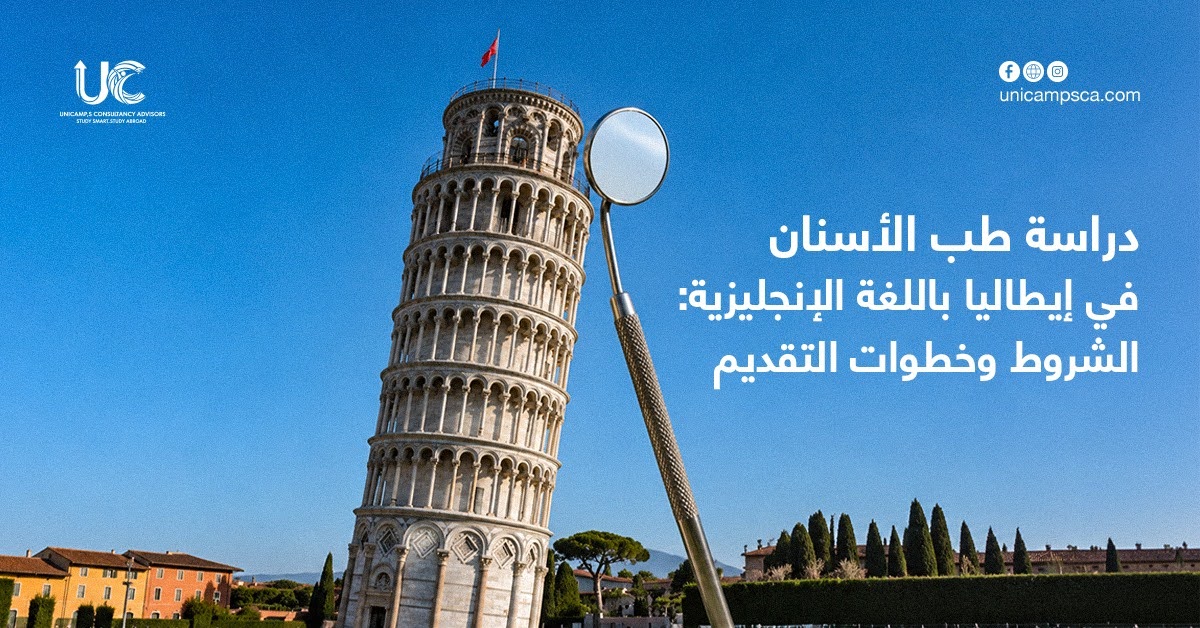
Study Dentistry in Italy in English: Admission Requirements, Top Universities & Application Guide 2026
If you dream of studying Dentistry in Europe and earning an internationally recognized degree from a prestigious university, Italy is one of the best destinations available for international students. In addition to its high-quality education, several Italian universities offer Dentistry programs taught entirely in English, allowing students to pursue their studies without having to master Italian before beginning their academic journey.
Over the past few years, interest in studying Dentistry in Italy has grown significantly among students from the Middle East and other international applicants. This is largely due to the affordable tuition fees compared to many other European countries, the strong reputation of Italian universities, and the advanced clinical training students receive throughout their studies.
In this comprehensive guide, you'll learn everything you need to know about studying Dentistry in Italy in English, including admission requirements, the best universities, application procedures, expected costs, and essential information to help you make an informed decision.
Why Do International Students Choose to Study Dentistry in Italy?
Italy has become one of the most attractive destinations for international students for several reasons, including:
Public universities with an excellent international reputation.
Dentistry programs taught in English.
Affordable tuition fees compared to the UK and the United States.
Degrees recognized internationally.
Extensive clinical training in modern university hospitals and dental clinics.
Access to scholarships and financial aid opportunities.
A safe European environment with a rich cultural and historical heritage.
Studying in Italy also gives students the opportunity to experience one of Europe's most culturally significant countries while receiving a world-class education.
Can You Study Dentistry in Italy in English?
Yes. A number of Italian universities offer Dentistry programs in English specifically designed for international students.
The curriculum typically includes:
Basic Medical Sciences
Head and Neck Anatomy
Preventive Dentistry
Prosthodontics
Oral Surgery
Endodontics
Orthodontics
Clinical Training
The entire program is delivered in English at universities offering this pathway, making Italy an excellent choice for students who wish to study Dentistry in Europe without completing the degree in Italian.
How Long Does It Take to Study Dentistry in Italy?
A Dentistry degree in Italy typically lasts five academic years.
The program is generally divided into two main phases:
Pre-Clinical Phase
During the first years, students study subjects such as:
Biology
Chemistry
Physics
Anatomy
Physiology
Pathology
This phase provides the scientific and medical foundation required before beginning clinical practice.
Clinical Phase
During the later years, students begin:
Clinical training in university dental clinics.
Treating patients under academic supervision.
Developing practical clinical skills.
Performing dental examinations and treatments.
This practical experience is one of the strongest aspects of studying Dentistry in Italy and prepares students for professional practice after graduation.
Admission Requirements for Studying Dentistry in Italy
Students must meet several admission requirements before applying.
High School Certificate
Applicants must hold a recognized secondary school qualification.
Italian universities accept a wide range of educational systems, including:
Egyptian Thanaweya Amma
Saudi High School Certificate
UAE Secondary School Certificate
International Baccalaureate (IB)
American High School Diploma (with AP subjects)
British Curriculum (IGCSE & A Levels)
Completion of 12 Years of Education
Students must have completed the equivalent of 12 years of pre-university education to qualify for direct admission.
Entrance Examination
Most public universities require applicants to pass a competitive entrance examination, which is one of the primary admission requirements for Dentistry programs.
English Language Proficiency
Since the program is taught in English, some universities may require proof of English proficiency through:
IELTS
TOEFL
Other universities may accept alternative methods of demonstrating English language competence, depending on their admission policies.
Required Documents
Applicants are usually required to submit:
A valid passport
High school certificate
Official academic transcripts
Passport-sized photographs
Completed application forms
Any additional documents requested by the university
Dentistry Entrance Examination in Italy
Admission to most Italian public universities is based on a competitive entrance examination designed to rank applicants according to their academic performance.
The exam generally covers:
Biology
Including topics such as:
Cell Biology
Genetics
Human Body Systems
Chemistry
Including:
General Chemistry
Organic Chemistry
Chemical Reactions
Physics
Such as:
Energy
Motion
Electricity
Mathematics and Logical Reasoning
These sections assess analytical thinking, problem-solving abilities, and quantitative reasoning.
The higher a student's score, the greater their chances of securing a place at their preferred university.
Best Universities to Study Dentistry in Italy
Italy is home to several highly respected universities offering outstanding Dentistry programs.
University of Siena
Founded more than 780 years ago, the University of Siena is one of Europe's oldest universities.
Its Dentistry program places a strong emphasis on clinical practice and direct patient interaction. With relatively smaller class sizes compared to larger universities, students often benefit from closer academic supervision and increased hands-on training opportunities.
Sapienza University of Rome
Sapienza University of Rome is the largest university in Europe and one of Italy's most internationally recognized institutions.
Its Faculty of Dentistry enjoys an excellent reputation in medical research and provides students with extensive clinical experience through one of Italy's largest university hospitals. Students also benefit from collaborations with international research centers and academic institutions.
Application Process for Studying Dentistry in Italy
If you are planning to study Dentistry in Italy in English, here are the main steps you should follow:
Step 1: Choose the Right University
Begin by comparing universities based on:
The curriculum and teaching approach.
Admission requirements.
Tuition fees.
The city and cost of living.
Clinical training opportunities.
Student support services.
Choosing the right university should be based on your academic profile, career goals, and budget—not just rankings.
Step 2: Prepare Your Documents
Gather all required documents, ensuring they are officially translated and legalized according to the university's and the Italian Embassy's requirements.
Typical documents include:
Valid passport.
High school certificate.
Academic transcripts.
Passport-sized photographs.
Language certificate (if required).
Additional documents requested by the university.
Preparing your documents early helps avoid unnecessary delays during the admission process.
Step 3: Register for the Entrance Examination
Most public universities require applicants to register for the official Dentistry entrance examination within the designated registration period each year.
Students are encouraged to monitor application deadlines carefully, as late registrations are generally not accepted.
Step 4: Submit Your University Application
Once all documents are ready, you can submit your application through the university's admission platform and complete all required registration procedures.
It is important to review every document carefully before submission to avoid delays or rejection due to incomplete applications.
Step 5: Receive Your Admission Letter
Students who meet the admission requirements and achieve the required entrance examination score will receive an official Letter of Acceptance from their university.
This document is one of the most important requirements for the student visa application.
Step 6: Apply for Your Student Visa
After receiving your university acceptance, you can begin the Italian student visa application process.
Depending on your country of residence, the required documents may include:
University admission letter.
Valid passport.
Financial proof.
Accommodation confirmation.
Health insurance.
Completed visa application forms.
Because visa processing times vary from one country to another, the Unicamps team always recommends starting the visa process as early as possible after receiving your admission.
Tuition Fees for Studying Dentistry in Italy
The cost of studying Dentistry in Italy varies depending on the university and the student's financial status.
Tuition Fees
At most Italian public universities, annual tuition fees typically range between:
€2,000 and €3,000 per year
The exact amount depends on the university's tuition policy and, in some cases, the student's declared family income.
Compared to many English-speaking countries, Italy remains one of Europe's most affordable destinations for obtaining a high-quality Dentistry degree.
Student Accommodation
Students generally have several accommodation options available:
University residences.
Shared apartments.
Private apartments.
The most suitable option depends on the student's budget, preferred lifestyle, and the availability of housing in the chosen city.
Based on Unicamps' experience, applying for accommodation early significantly increases the chances of securing affordable housing before the academic year begins.
Living Expenses in Italy
Monthly living costs typically include:
Food.
Public transportation.
Internet and utilities.
Personal expenses.
Living costs vary depending on the city.
Major cities such as Rome and Milan are generally more expensive than smaller university cities. Careful financial planning before departure helps students manage their expenses comfortably throughout the academic year.
Scholarships for Dentistry Students in Italy
Yes. Many Italian universities and regional authorities offer scholarships and financial aid for international students.
These may include:
Partial tuition fee waivers.
Full tuition fee exemptions.
Accommodation support.
Monthly living allowances.
Merit-based or need-based scholarships.
These opportunities can significantly reduce the overall cost of studying Dentistry in Italy, making higher education more accessible to international students.
Students are encouraged to check scholarship eligibility requirements each academic year, as criteria may vary by university and region.
Career Opportunities After Graduation
Graduating from an Italian Dentistry program opens the door to a wide range of professional opportunities.
Graduates may choose to:
Continue postgraduate education.
Specialize in one of the dental specialties.
Apply for residency or professional training programs.
Work after fulfilling the licensing requirements in their chosen country.
Pursue research or academic careers.
Italian Dentistry degrees enjoy an excellent international reputation, although graduates should always verify the licensing and recognition requirements in the country where they intend to practice.
Italian universities also place strong emphasis on clinical education, giving graduates valuable practical experience before entering the job market.
Why Choose Unicamps?
At Unicamps, we support international students throughout every stage of their journey to study Dentistry in Italy. Our goal is not only to help you secure university admission but also to ensure that you are fully prepared for every step before and after your arrival.
Our services include:
Evaluating your academic profile and recommending the most suitable university.
Explaining admission requirements and application procedures in detail.
Assisting with entrance examination registration.
Preparing, translating, and legalizing required documents.
Submitting university applications.
Supporting students throughout the Italian student visa process.
Assisting with accommodation arrangements.
Providing pre-departure guidance and post-arrival support.
Following up with students until they successfully begin their studies.
At Unicamps, we believe that studying abroad should be a well-planned journey, not a stressful process. Our experienced advisors are committed to helping students make informed decisions and achieve their academic goals with confidence.
Frequently Asked Questions (FAQ)
Can I study Dentistry in Italy entirely in English?
Yes. Several Italian universities offer full Dentistry programs taught entirely in English for international students.
How long does it take to complete a Dentistry degree in Italy?
A Dentistry program in Italy typically lasts five academic years, combining theoretical education with extensive clinical training.
Is there an entrance examination?
Yes. Most Italian public universities require applicants to pass a competitive entrance examination as part of the admission process.
Are scholarships available?
Yes. Many universities and regional authorities offer scholarships and financial aid for eligible international students. Scholarship availability and eligibility criteria vary depending on the university and region.
Is an Italian Dentistry degree internationally recognized?
Yes. Degrees awarded by accredited Italian universities are internationally recognized. However, graduates should always check the licensing and recognition requirements in the country where they intend to practice after graduation.
Can I apply immediately after high school?
Yes. International students can apply directly after completing an eligible secondary school qualification, provided they meet the university's admission requirements and have completed the required years of education.
Do I need an IELTS or TOEFL certificate?
It depends on the university. While some institutions require proof of English language proficiency through IELTS or TOEFL, others may accept alternative qualifications or have different language requirements.
When should I start my application?
Because admission procedures, document preparation, translations, legalizations, and visa processing all require time, Unicamps recommends starting your application several months before the intended intake.
Early preparation provides more university options and allows sufficient time to complete all required procedures without unnecessary pressure.
Start Your Journey with Unicamps
Studying Dentistry in Italy offers an excellent opportunity to receive a high-quality European education, gain valuable clinical experience, and earn an internationally recognized degree.
Whether you are still exploring your options or are ready to begin your application, the Unicamps team is here to guide you through every stage of the process—from choosing the right university to arriving in Italy and starting your academic journey.