
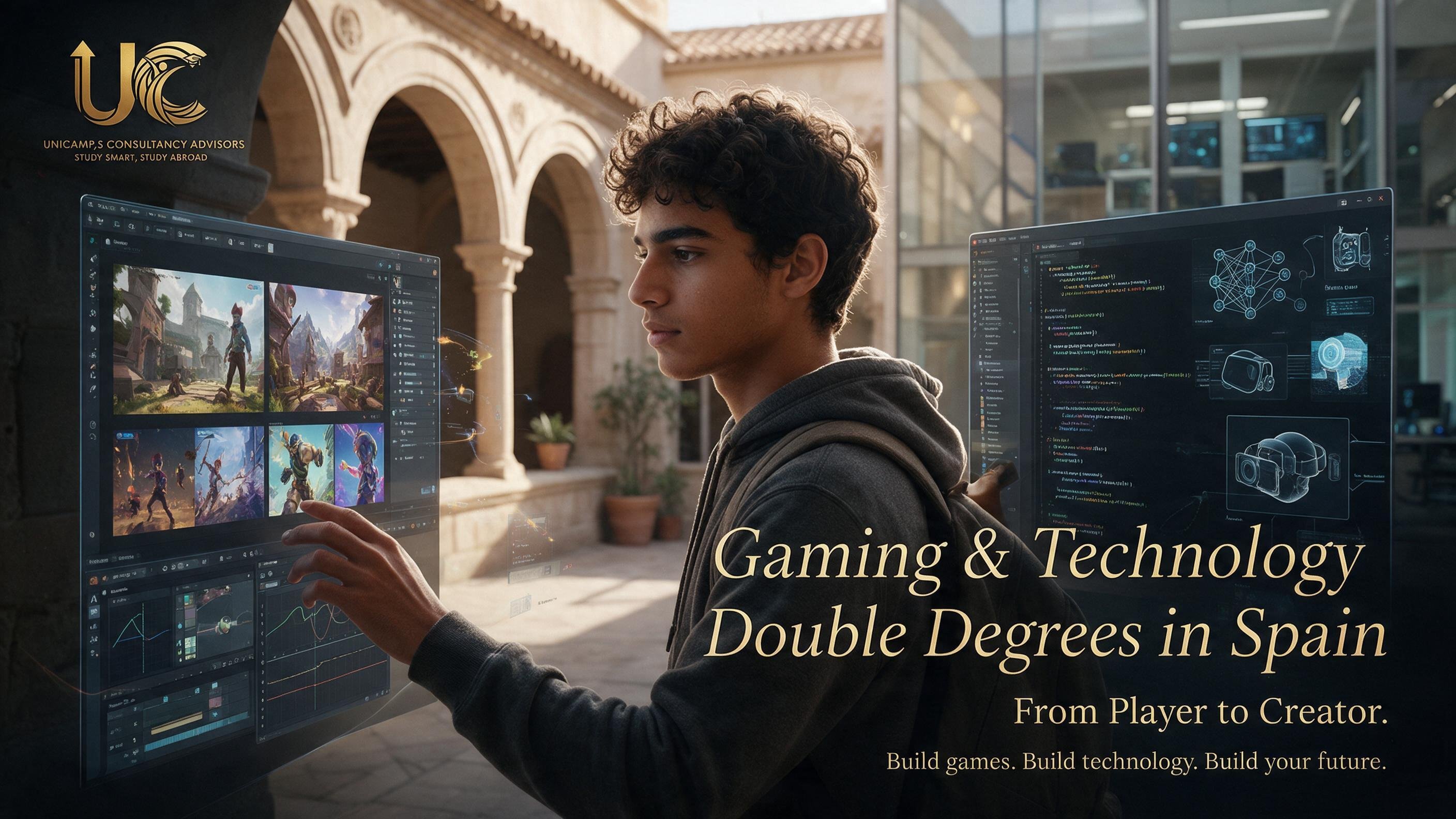
Gaming and Technology Double Degrees in Spain: From Player to Creator
For many students, gaming begins as entertainment.
But behind every modern game is a multidisciplinary team working across programming, engineering, artificial intelligence, physics, 3D modelling, animation, networking, storytelling and user experience.
That is why studying Gaming at university can look very different from simply learning how to design a game.
In Spain, students can find Double Degrees that combine gaming with Computer Engineering, Computer Science, Animation and Audiovisual Communication, creating very different professional profiles.
Gaming + Computer Engineering
One current example is the Double Degree in Video Game Design and Development + Computer Engineering at Universidad Rey Juan Carlos.
The programme is taught on campus in Móstoles, lasts five years and carries 303 ECTS. First-year subjects include Physics for Video Games, Logic and Discrete Mathematics, Visual Programming, Computer Technology, Data Structures, Game Design and Geometric Modelling. Universidad Rey Juan Carlos
This is important because the student is not studying game design alone.
The programme also develops knowledge in computing, systems, programming and technical foundations.
Potential career directions may include game programming, gameplay engineering, software development, simulation, computer systems and interactive applications.
Computer Science + Video Game Development
Other programmes place even more emphasis on software and computing.
Universidad San Jorge currently offers a Double Degree in Computer Engineering + Video Game Design and Development, combining creative game-development skills with software and hardware knowledge. USJ
Its current curriculum includes subjects connected to software, mobile development, artificial intelligence for video games and communication systems. Some subjects are taught primarily in English, with Spanish as a secondary teaching language. GDWeb
This type of combination may suit students who want gaming to be part of a broader technical career rather than their only professional option.
Animation + Video Games
Not every gaming student wants to become a programmer.
Students interested in art, characters, 3D environments, movement and visual storytelling may prefer a more creative combination.
Universidad Europea de Madrid currently offers an official Double Degree in Animation + Video Game Design lasting five years and 360 ECTS, taught in Spanish.
The programme combines 2D and 3D animation, character design, modelling, VFX and digital art with game design, gameplay, programming and professional game engines such as Unity and Unreal Engine. Universidad Europea Creative Campus
Possible career areas include animation, 3D art, character and environment design, game design, technical art and VFX.
Gaming + Audiovisual Communication
Another route connects games with film, media and digital storytelling.
Universidad Loyola currently offers a 360-ECTS Double Degree in Audiovisual Communication + Video Game Creation and Digital Animation in Seville.
Its curriculum combines audiovisual production with game and animation projects, 3D modelling, intelligent systems and immersive technologies including VR and 360° media. Universidad Loyola
This can suit students whose interests sit between gaming, film, storytelling, production and digital content.
What About VR and AR?
Virtual and Augmented Reality often appear inside broader gaming and interactive-technology programmes rather than as completely separate degrees.
Current Spanish curricula include subjects such as Interactive Environments and Virtual Reality, Augmented Reality and immersive technologies. PSICología UCM
These skills can have applications beyond entertainment, including training, education, healthcare, architecture, real estate, tourism and simulation.
What Will You Actually Study?
Depending on the programme, students may encounter areas such as:
Programming and algorithms.
Data structures and computer architecture.
Artificial intelligence.
Game engines and gameplay programming.
Game physics.
3D modelling and animation.
Character and environment design.
Narrative and storyboarding.
VR, AR and simulation.
User experience and interactive environments.
This is why students should always examine the actual curriculum, not simply choose a degree because the word “Gaming” appears in the title.
Loving Games Is Not Enough
There is a major difference between playing games and building them.
Development can involve debugging code, solving mathematical problems, optimising performance, designing systems, testing mechanics and repeatedly rebuilding features that do not work as expected.
A student who enjoys games but strongly dislikes mathematics, programming and technical problem-solving may not enjoy a Computer Engineering + Gaming pathway.
A creative Animation + Gaming route may be more appropriate.
The programme should match the student, not just the hobby.
Career Opportunities
Depending on the degree and the skills developed, career directions can include:
Game Developer
Gameplay Programmer
Software Developer
Game Designer
Technical Artist
3D Artist
Animator
Simulation Developer
VR/AR Developer
Interactive Experience Developer
Level Designer
Game Producer
In this industry, however, the degree title is only part of the story.
A strong portfolio and practical projects can be extremely important.
Employers need to see what students can actually build.
Is Gaming Relevant to Gulf Careers?
The regional gaming ecosystem is developing significantly.
Dubai’s official Dubai Program for Gaming 2033 aims to support developers, designers, programmers and gaming companies, with a stated target of creating up to 30,000 gaming-related jobs by 2033. Dubai Gaming
Saudi Arabia’s National Gaming and Esports Strategy aims to position the Kingdom as a global gaming hub by 2030 and includes goals related to local game development and job creation. الوكالة العربية للأخبار
This does not guarantee employment for every gaming graduate.
It does, however, mean that gaming, interactive technology, programming and digital-content skills are increasingly relevant to a regional industry that is receiving significant strategic investment.
Gaming Degree or Gaming + Computer Engineering?
Consider a technical combination if you enjoy:
Programming.
Mathematics.
Computer systems.
Technology.
Problem-solving.
And you want broader opportunities outside gaming as well.
Consider Animation + Gaming if you are stronger in:
Art.
3D design.
Animation.
Characters.
Visual storytelling.
Consider Gaming + Audiovisual Communication if your strengths are closer to:
Film.
Production.
Narrative.
Digital content.
Interactive media.
There is no single combination that is best for every student.
Programme Duration
Current examples show how structures differ.
URJC's Gaming + Computer Engineering Double Degree lasts five years and 303 ECTS. Universidad Rey Juan Carlos
Universidad Europea's Animation + Video Game Design programme lasts five years and 360 ECTS. Universidad Europea Creative Campus
Universidad Loyola's Audiovisual Communication + Video Games and Digital Animation programme contains 360 ECTS. Universidad Loyola
Students therefore need to check the specific workload and curriculum of each programme.
Language of Study
Teaching language varies by university.
Universidad Europea currently lists its Animation + Video Game Design Double Degree as taught in Spanish. Universidad Europea Creative Campus
Other programmes may include individual subjects delivered in English within a wider Spanish-language curriculum. GDWeb
International students should therefore verify the language of the whole programme, not just selected modules.
Where Can a Foundation Year Help?
Students who do not yet have the required Spanish level, or who need preparation for the Spanish university admissions system, may benefit from a Foundation Year before beginning the degree.
Depending on the student's background, this can help with:
Spanish-language development.
Academic preparation.
Admission requirements.
Entrance-exam preparation.
Transition into Spanish university study.
The need for a Foundation Year depends on the student's secondary qualification, current language level and target university.
Tuition Fees
Costs vary substantially between public and private institutions.
Public-university tuition depends on the region, field and number of ECTS enrolled, while private universities set their own programme fees.
The general Unicamps campaign message that some Spanish public-university options can start at around €600 per year should not be interpreted as the specific price of every Gaming Double Degree.
For each individual programme, we will review current official tuition directly from the university before recommending it.
Who Is This Route For?
Gaming + Technology may be worth considering if you:
enjoy technology as much as gaming,
are prepared for programming and mathematics,
like building projects,
enjoy problem-solving,
are willing to develop a portfolio,
and want career options both inside and beyond the gaming industry.
The important question is not:
What games do you play?
It is:
What are you capable of building?
📲 WhatsApp: +971 54 457 3389
🌐 Book your consultation:
https://unicampsca.com/book-consultation
Unicamp S Consultancy Advisors
Study Smart. Study Abroad.