
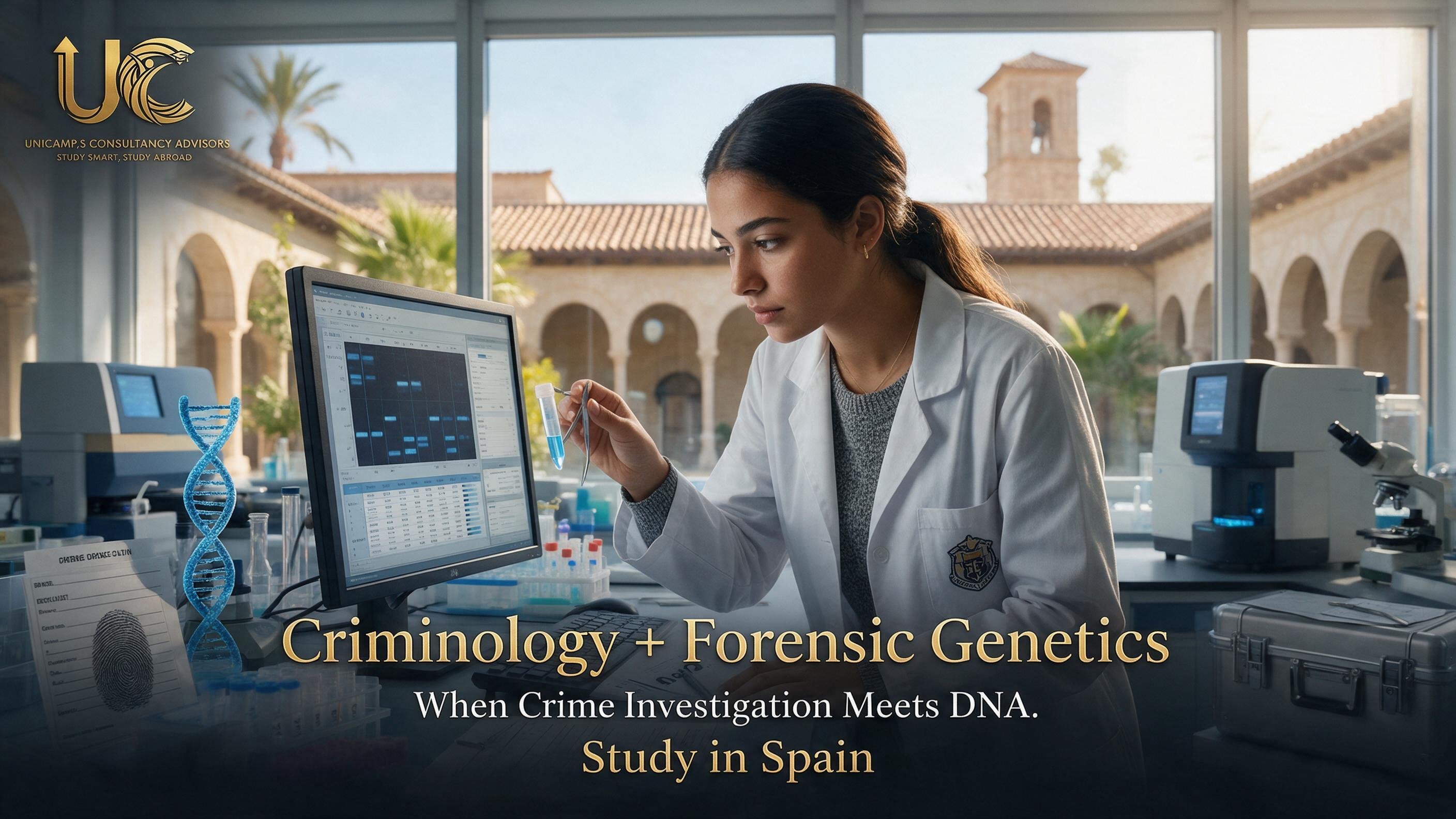
Criminology + Forensic Genetics: Where Crime Investigation Meets DNA
Criminology and Genetics may initially appear to be completely different academic fields.
Criminology examines crime, criminal behaviour, justice, prevention and the social and psychological factors surrounding offending.
Genetics studies DNA, inheritance and biological variation.
Their most important professional intersection is Forensic Genetics.
Forensic Genetics uses DNA and biological evidence to support criminal investigations, human identification, missing-person cases and the analysis of unidentified remains.
INTERPOL explains that DNA profiles can help associate or exclude individuals from crime-scene evidence, link separate crimes and identify missing persons or disaster victims.
Criminology Is Not the Same as Forensic Science
Criminology often asks:
Why did the crime happen?
What social, psychological or behavioural factors were involved?
How can crime be prevented?
How should justice and security systems respond?
Forensic Science and Criminalistics ask another question:
What physical evidence did the event leave behind?
This can include:
DNA
Blood
Hair
Fingerprints
Toxicology
Human remains
Digital evidence
Trace materials
The University of Alcalá currently offers a Bachelor’s Degree in Criminalistics: Forensic Sciences and Technologies that combines science, technology and legal knowledge for crime and evidence analysis. The programme includes practical work with DNA, human remains, fingerprints, toxicological evidence and digital evidence.
Where Does Genetics Enter the Investigation?
Biological material recovered from a crime scene can potentially produce a DNA profile.
Forensic scientists may use that profile to:
associate biological evidence with an individual,
exclude a suspect,
link different crime scenes,
help identify unknown human remains,
or support missing-person investigations.
NIST describes forensic genetics as a specialised scientific field involving DNA profiling, genetic markers, laboratory methods and quality standards for human identification and forensic analysis.
Does Genetics Predict Criminal Behaviour?
No.
Forensic Genetics should not be confused with the idea that DNA can simply identify who is “genetically criminal”.
Human behaviour is complex and cannot responsibly be reduced to a single genetic explanation.
In forensic investigation, genetics is primarily used as an evidence and identification tool.
The question is not:
“Will this person commit a crime?”
It is more often:
“Does this biological evidence have a scientifically supported relationship to this individual or case?”
Can Students Study Criminology and Forensic Genetics Together in Spain?
Yes, although not necessarily through a programme formally called a “Criminology + Genetics Double Degree”.
There are several academic routes.
Criminology with Forensic Genetics
Complutense University of Madrid currently offers a four-year, 240-ECTS Bachelor’s Degree in Criminology taught in Spanish. Its 2026/27 study plan includes a 4-ECTS elective in Forensic Genetics.
This allows a Criminology student to gain exposure to forensic genetic evidence.
However, it does not provide the same scientific laboratory preparation as a full genetics or forensic-science degree.
Criminalistics + Forensic Genetics
For students who want a much stronger laboratory-science component, the University of Alcalá offers its four-year, 240-ECTS degree in Criminalistics: Forensic Sciences and Technologies.
The curriculum begins with Biology, Chemistry, Physics and Mathematics alongside Criminalistics and Criminology.
The programme includes a compulsory 6-ECTS Forensic Genetics course and an optional 6-ECTS Applied Forensic Genetics course.
This creates a much deeper connection between crime investigation, biology and DNA analysis.
Missing Persons and Human Identification
Forensic genetics is also important beyond traditional crime-scene investigation.
INTERPOL’s I-Familia system uses family DNA matching to help identify missing persons and unidentified human remains when direct DNA comparison is not available.
This means forensic genetic work can contribute to:
Missing-person investigations
Disaster Victim Identification
Human remains identification
Kinship analysis
International investigations
Career Directions
Depending on the student’s scientific preparation, possible areas may include:
Forensic Biology
Forensic DNA Analysis
Forensic Genetics
Crime Laboratory Work
Crime Scene Investigation
Human Identification
Missing Persons Investigation
Forensic Research
Evidence Analysis
Students should understand an important distinction:
A Criminology Degree alone may not qualify someone to work as a laboratory DNA scientist.
Students who specifically want hands-on forensic DNA laboratory careers may be better served by a strong science pathway such as:
Criminalistics / Forensic Science
or:
Biology / Genetics followed by Forensic Genetics specialisation.
Foundation Year Preparation
For students entering a science-heavy forensic route, a Foundation Year can provide valuable preparation.
Unicamps Foundation Year pathways typically cost approximately:
€4,000–€7,900
and can support progression toward B2 Spanish, university admission preparation and subject preparation in areas such as:
Biology
Chemistry
Mathematics
Physics
depending on the target programme.
The University of Alcalá itself recommends incoming Criminalistics students have basic pre-university knowledge in Biology, Chemistry, Physics and Mathematics, and requires non-Spanish-speaking international applicants to demonstrate sufficient knowledge of the programme’s teaching language.
The Bigger Idea
Combining Criminology and Genetics should not be presented as a search for a “crime gene”.
The academically meaningful intersection is Forensic Genetics.
Criminology helps students understand crime and the systems surrounding it.
Forensic Genetics helps them understand the biological evidence crime may leave behind.
Criminology asks why.
Forensic Genetics helps establish who, or sometimes what evidence can prove.
📲 WhatsApp: +971 54 457 3389
🌐 Book your consultation:
unicampsca.com/book-consultation